

Building My Creative Routine This Year & Slowing Down…
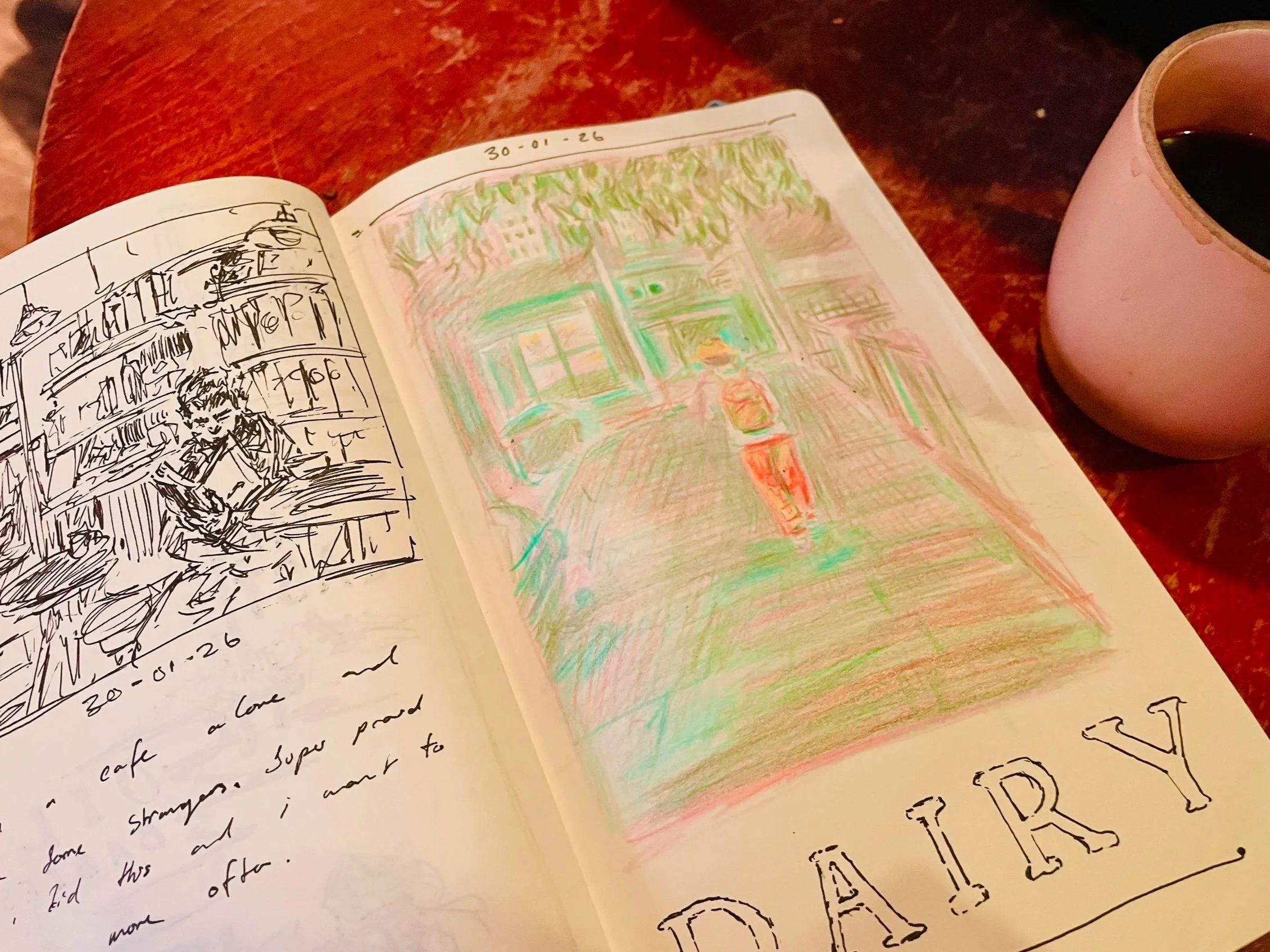
Photo of my sketchbook journal with a pencil drawing and pen sketch.
Todays Song: Hush Kids — Morning Is Made
Todays Colour: Warm Yellow / Yellow Ochre
As we make it past the first week of February, I still haven’t finished a full painting. I’ve put 43 out of 200 posters up across the city, filled in one page of my new sketchbook (a sketchbook I wanted to completely fill in January), had two panic attacks in one week, and read a quarter of a book since starting it in December.
I feel behind, and not on task. At all…
But I have spent valuable time with friends. I’ve spent time planning my year ahead and what I want to accomplish, finished illustrating a present for my partner (still working on the text), and I’ve been trying to sketch and journal every day when I can. I’ve also been reading if I’m not feeling up to sketching, and I’ve been meeting my childhood friend regularly to knit too.
I’ve deleted Instagram from my phone and tried to limit my use of it, only using it for work posts (which are rare right now), and occasional check-ins for messages. I’ve noticed more people talking about deleting Instagram because of its toxic algorithms and the dreaded doom-scrolling void, including friends and businesses I’ve met during my postering adventures.
January started with a lot of expectation. That familiar “new year, new start” feeling (because isn’t everyone thinking the same?) and the need to believe we’re heading into something better and brighter. A lot of people I know had a rough 2025, and really need 2026 to be kinder. So let’s step into it and hope for the best.
A small morning reset
This morning, I rolled out of bed and my routine felt a little shaky. Some things were unpredictable. But I breathed through it. I ate something. I had a coffee with my partner. I journalled through the anxiety. Then I walked over to a familiar café to bring myself back from the off-piste morning routine I’m used to.
I took in the brief sunshine, and I saw a lovely yellow image of some birds that a student shared in our group chat. It reminded me how much I love the colour yellow. I sat and quickly sketched a man waiting for his order. I read an exciting chapter of Project Hail Mary, finished my pain au chocolat and my oat cappuccino, then walked home slowly, listening to a song my partner sent me. It also happened to have a yellow cover image, and it felt warm to listen to.
My mind floated back to a photo I took of someone walking down the street in warm shades of yellow and orange. It’s a colour I’ve been missing this winter so far, while patiently waiting for spring to begin.
Thinking about “slow art”
I wanted to explore being slow in art this week and maybe this past month.
Sometimes “slow” has such a negative connotation. It can sound like waiting for something, or that something is stupid, or not quick-witted enough. Fast is always instant, quick, smart. But fast can also feel overwhelming, power-oriented, rushed and to me, strangely non-observant.
Slowness also feels like it’s creeping into the realm of luxury, just like reading. In our current world everything is so damn fast, and time feels like a resource people are desperately clawing at. Giving your time away, choosing to spend it intentionally, is precious. So maybe it makes sense that we want everything else to be fast, so we can finally enjoy the time we actually want.
Watercolour painting as a slow medium
For me, watercolour keeps falling into this slowness category (I guess a lot of art does). It makes you stop. It forces you to wait. It encourages you to observe.
But this only seems to show up in the making of it. Even in galleries, everything can feel rushed again. The average person probably spends less than 30 or 40 seconds with a painting before taking a photo. Sometimes it’s just to post it for cultural kudos, then never really remembering to look at it again.
What I’ve learned from sketching what’s in front of me daily, just before I journal, is that it grounds me. I start to slow down and observe the people around me. I see, hear, and smell the room more vividly. I notice the light, textures, and shapes of the space. It places me in the space.
And although for a moment I feel like an observer of the room, once I finish the sketch I get pulled back into my body. Then I can write about my feelings, and how my mental health is doing in that moment. So I end up with both. My external and internal observations on paper to look back on.
I don’t always do this with watercolour in the same way, but I find it’s an even slower approach. It slows down my mind and makes me soak in the colours and brushstrokes on the page.
Sometimes I’m painting from a photo I took years ago, or recently, and I get transported back into it. Where I was when I took it, and what it felt like. I try my best to paint that onto the page, not just the image.
Other times, it’s a photo taken before I even existed, and my mind wanders. What was it like then? What were they talking about? Was it hot or cold? What time of year was it?
As each layer dries and I add another, the colours become more vibrant, revealing more complexity. Before I know it, a few hours have slipped by. My head feels calm, my thoughts are quieter, and I feel grounded in my room.
Watercolour is probably the only medium I’ve used that truly tests your patience. You’re forced to wait for the result. You can’t always speed it up, and sometimes, depending on the weather, you can’t slow it down either. It’s unpredictable. You have to learn to work with it, not control it. Learning how it behaves, and what happens when you do certain things, adds a little control, but depending on the paint, the paper, and the amount of water, it can still surprise you.
Part 2: Watercolour’s domestic history…